Search

  • Mobile Elevating Work Platforms (MEWPs) are provided with ground and platform controls to comply with global MEWP design standards. Pedestrian control is the term used when the MEWP operator uses the platform controls from the ground by walking alongside, or in close proximity to the MEWP. This includes those that have an umbilical cord, or radio/remote, or a fixed point of control on the chassis.

  • IPAF’s globally recognised PAL Card operator training has launched in a new language and new territory – with member firm Riwal now delivering the operator course in Russian to training candidates in Atyrau, Kazakhstan.

  • IPAF is pleased to again support UK Associations Week (17-21 June), which offers a chance for all British trade and membership organisations to celebrate the work they do, having been established in 2017 by the Institute of Association Leadership (IAL).

  • If a MEWP (Mobile Elevating Work Platform) or platform occupant contacts energized power lines it can cause, electrocution, electric shock, fire, or an explosion. The same effects can occur without contacting a power line by arcing or flashover of electrical energy to a conductor.

  • IPAF continues to grow with over 1,600 members in 80 countries and regions. We are committed to supporting our members in accessing IPAF’s services, providing timely and accurate guidance and advice in a friendly and helpful manner. 

  • The delivery and collection of Mobile Elevating Work Platforms (MEWPs) can sometimes be a high-risk activity if not performed correctly. IPAF recommends load/unload and IPAF demonstrator training for delivery drivers.

    Document cover mockup for social and website-TE-1108-EN--V1.0-2026-01-20
  • Directives, Laws & Standards

    United States - MEWP Regulations and Standards

    Information on, and links to, the United States regulations and standards for Mobile Elevating Work Platforms (MEWPs), formally known as Aerial Work Platforms (AWPs).

  • Falls from the platform, electrocution and platform overturns are the most common incidents leading to serious injuries and deaths over the past ten years, according to the latest IPAF Global Safety Report, based on analysis of anonymised accident data.

  • Ground conditions are critical for the stability of the mobile elevating work platform (MEWP). Unsuitable ground conditions can result in the MEWP overturning with potential loss of life.

  • IPAF has agreed an official memorandum of understanding, committing to close co-operation with one of India’s leading occupational health & safety bodies, which was signed at the OSH India safety event in Mumbai at the end of November 2018.

  • What does the analysis of accident data from around the world teach us about safety in powered access? That is the important question under consideration in an upcoming instalment of an ongoing series of free webinars delivered by IPAF and guest experts.

  • Mobile Elevating Work Platform (MEWP) field servicing often carries higher risks than workshop servicing.

  • Set for November 19-20 in Nashville, USA, the inaugural Working at Height Conference & Awards, jointly organised by the International Powered Access Federation (IPAF) and Access, Lift & Handlers (ALH) magazine, will place a spotlight on the utilisation of aerial platforms to enhance site productivity and safety.

  • The International Powered Access Federation (IPAF) announces the launch of its new Construction Hoist (CH) Installer and Advanced Installer Training Courses. These courses are designed to equip operatives with the necessary knowledge and skills to safely install, maintain, examine, and dismantle construction hoists, adhering to legal obligations and industry best practices.

  • Mobile Elevating Work Platforms (MEWPs) are supplied with both ground and platform controls to comply with International MEWP design standards. Manufacturer’s operators’ manuals identify that the primary operator control station is in the platform and that the ground controls should only be used to carry out pre-use inspections without anyone in the platform, or for emergency descent purposes as part of a rescue plan.

  • CRUSHING CAN KILL - STAY ALERT, STAY ALIVE
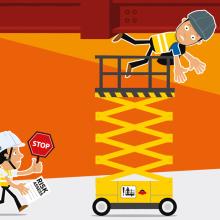
    Mobile Elevating Work Platforms (MEWPs) are often used to carry out work in areas where there are risks of crushing or entrapment to the platform occupants. Any activity involving MEWPs must be planned and properly managed. Failure to do so can result in injury or death of the platform occupants.

    Crushing Can Kill 2024 Website Header
  • THE RENTAL STANDARD YOU CAN TRUST FOR YOUR MEWP, MCWP & Construction Hoist HIRE & RENTAL

    IPAF Rental+ provides assurance to customers at every stage of the Mobile Elevating Work Platform (MEWP), Mast Climbing Work Platform (MCWP) and Construction Hoist (CH) hire/r

  • The International Powered Access Federation (IPAF) has modified its eLearning operator theory module to include facial recognition technology currently deployed as a security measure on its MEWPs for Managers eLearning course. By utilising the camera on the candidate’s device or computer, this ensures only the trainee under assessment is able to undergo the eLearning.

  • IPAF’s Women in Powered Access Initiative aims to recognize and celebrate the contributions of women in powered access, as well as outlining career pathways for women both already in the industry and those looking to enter it. 

  • Why do you need rescue procedures? A robust, documented rescue procedure is required to lower the Mobile Elevating Work Platform (MEWP) platform occupants in a timely manner in case of a malfunction or emergency. Any delay in rescuing the MEWP platform occupants may be the difference between life and death.

  • IPAF has seen a surge of new members, taking the total number beyond the 1,500 mark. The increase is partly owing to the powered access industry’s strong recovery after the pandemic and partly the introduction of a new Safety Professional category.

  • An agreement between IPAF and a local chapter of the National Safety Council of India will see the two organisations work together in the state of Kerala to spread awareness about key risks and mitigations when working at height.

  • A series of virtual workshops to assist and support those who regularly carry out third party inspections of MEWPs and MCWPs will be hosted by IPAF to meet demand, which is high across the Middle East and South Asian countries.

  • A promising future lies ahead for members of IPAF Switzerland, which celebrates its 18th birthday this year with announcements on key improvements to its quality MEWP training programme, including updates to courses, digitalisation of delivery and the ePAL mobile app that already has more than 2,000 daily Swiss users.