|
Resources  |
 |

Membership
-
-
-
IPAF is registered with the UK Financial Services Authority as an industrial and provident society (No. 30998R) and therefore must have two levels of membership: • Full members who have full voting rights and full access to all member services, and • Associate members (associations, company associates, press, individual associates and small users) who do not have full voting rights, but have full access to all member services.
-
A proposer or seconder needs to be a senior manager or director within their organisation deemed to be able to speak for and represent their organisation.
Associate members may not act as proposers and seconders. Independent instructors may propose and second instructors, but not companies.
Training
-
Council Directive 2009/104/EC concerning the minimum safety and health requirements for the use of work equipment by workers at work OJ L260/5 Article 9 states: "Without prejudice to Article 12 of Directive 89/391/EEC, the employer shall take the measures necessary to ensure that: (a) workers given the task of using work equipment receive adequate training, including training on any risks which such use may entail; (b) workers referred to in the second indent of Article 6(b) receive adequate specific training." Article 6(b) states: "in the case of repairs, modifications, maintenance or servicing, the workers concerned are specifically designated to carry out such work."
-
-
In order to deliver IPAF training courses, you need to be employed by an IPAF training centre or become a registered IPAF independent instructor member.
To become an IPAF instructor, you must meet the following criteria:
• 36 months’ MEWP operating experience • IPAF Operator Licence held for 6 months minimum • IPAF Demonstrator Licence held for 3 months minimum • IPAF MEWPs for Managers course successfully completed • Evidence of Acceptable Instructional Techniques training (3 days minimum) • Successful completion of an approved Harness Instructor course • Evidence of IPAF MEWP-specific Instructor training (4 days minimum) • Evidence of HSE required standard for First Aid at Work training level • Successful completion of IPAF Instructor Examination • Mentoring (Full details are in the IPAF MEWP Operations Manual, Chapter 2.1.2)
To become an independent instructor member, please e-mail the IPAF Instructor Administration Officer.
-
If operators want to add a category to their PAL Card, they need to successfully complete the IPAF approved Theory Test Paper. In addition to this, they must achieve the required standard when operating each of the machine categories that they wish to add on to their PAL Card.
If demonstrators want to add a category to their PAL Card, they must do the operator theory test and practical test on that category, then do the demonstrator course.
-
If you contact the IPAF training centre where you were trained, they will be able to replace your licence for a small fee.
-
Contact an IPAF training centre. Only operators or demonstrators who have been filling out their log books (60 entries over 5 years, 10 of which should be in the final year prior to expiry) will be eligible for a renewal test. Those who have not been filling out their log books will have to re-sit the operator course again.
All renewals must be done before the expiry date. Otherwise, an operator will have to do a full operator course and a demonstrator must do the full operator and demonstrator course.
Full details are in the IPAF MEWP Operations Manual, Chapter 2.2.2.
-
Yes, provided that there are suitable facilities and equipment. Please discuss with your selected training centre.
-
The International Powered Access Federation (IPAF) scheme is an operative record scheme approved by many sites worldwide including the UK Contractors Group (UKCG) and individuals holding an IPAF qualification should be welcomed on UKCG sites.
See references from the UKCG and ConstructionSkills.
-
The PAL Card is increasingly recognised worldwide. However, the employer and usually also the self-employed have a duty to know and abide by the legislation of the country they are planning to work in. IPAF may be able to assist with a summary of the legislation for countries in which we operate (please contact the IPAF head office in the UK). Ultimately it will be down to the site manager or equivalent at the differing work sites in each country to decide whether they are willing to accept the training you have received. IPAF's increasing worldwide reputation means that the PAL Card’s acceptance is growing daily.
-
Safety awareness relevant to MEWPs is an integral part of the IPAF course and therefore previous safety awareness is not necessary for the operator, demonstrator and instructor courses.
Some sites do however require a health and safety test prior to working on their site. See: http://www.cskills.org/supportbusiness/healthsafety/test/index.aspx
-
IPAF suggests that the operator should have the issued card on his/her person at all times when working with MEWPs and the employer should keep the certificate.
-
Yes, you need training, and there is a half-day course for this. If you have an existing licence with Static Vertical (1a), Mobile Vertical (3a) or the old category Scissor Lift (SL), you will only require familiarisation on the machine, which should be recorded in your IPAF log book.
-
No action is required. Simply upload applications for the successful candidates after the course.
-
As long as the matrix numbers are not exceeded, no action is required. If the matrix numbers are exceeded, you can either use sufficient additional instructors on the course or you will have to turn those not booked on the course away.
-
No, the individual pre-theory errors do not need to be listed, just the total pre-theory test result/mark.
-
Yes, however, this may affect the length of the course and/or the candidates’ likelihood of passing.
-
It is possible for the candidate to re-take the course the following day. However, it is recommended that the candidate, employer and instructor discuss the reasons for failing prior to a re-take so that any appropriate corrective action can be taken. A failure of either the theory or practical test means that the applicant will have to re-sit the entire course on another day.
-
Practical tests not taking place immediately following the theory test must be undertaken within the subsequent four-week period. After the four-week period, in order to renew or upgrade a licence, an operator must successfully complete the IPAF Renewal/Upgrade theory course and test, which is shorter than the theory part of the main operator course. If the practical part of the course has been rescheduled due to poor weather etc., then practical tests not taking place immediately following the theory test must be undertaken within the subsequent four-week period.
-
Training centres should retain these records for a minimum of six years.
-
Yes, but this does NOT allow you to exceed the numbers in the matrix.
-
Yes, the results of the risk assessment should be documented (3.3.7) and retained with the rest of the course paperwork.
-
PAL Cards remain the property of IPAF Ltd.
-
The log book is an operator’s record of machine usage/experience and whilst it can be signed by the operator, it acts as better evidence and therefore should preferably be signed by the site manager/employer/supervisor.
-
Responsibility for ensuring a PAL Card is current remains with either the operator or the employer (this will vary depending on their contractual relationship). The relevant training centres will however often endeavour to remind the operator or employer.
-
Only operators who have been filling out their log books (over five years the log book should have at least 60 entries, 10 of which should be in the final year prior to expiry) will be eligible for a half-day renewal test. If not, then the operator must take the full course again.
-
A maximum of six practical renewal tests can be done in a half-day course as long as all candidates have been filling in their log books. Only operators who have been filling out their log books (over five years the log book should have at least 60 entries, 10 of which should be in the final year prior to expiry) will be eligible for a renewal test.
-
In the event that an operator or demonstrator does not have a filled-in logbook, he or she will need to take the operator course, and in the case of a demonstrator, the operator and demonstrator courses.
-
An expired operator or demonstrator PAL Card cannot be renewed and will require full re-training and testing.
-
A nominated instructor is an instructor who is allocated to one specific training centre to help ensure that the training centre is run in accordance with the IPAF Operations Manual. An independent instructor can also act as the nominated instructor for one specific training centre only after having signed the agreement (2.3.4).
-
In cases where the approved instructor is not employed by the training centre concerned, an “Association Agreement” (2.3.2) must be in place and its requirements complied with.
-
This will depend on the experience of the candidate and any country-specific requirements. Please contact IPAF for further details (info ipaf-training.com).
-
No, it is not necessary for the training centre to employ an instructor as long as it has a nominated instructor.
-
This will depend on the experience of the candidate and any country-specific requirements. Please contact IPAF for further details (info ipaf-training.com).
-
An IPAF audit is an evaluation of either facilities, paperwork or course delivery against the requirements as set out in the IPAF Operations Manual.
-
The initial audit is to ensure that a company has the facilities required to become an IPAF training centre. An annual audit is to ensure that the training centre’s paperwork and facilities are being maintained as per IPAF requirements. An unannounced audit is to check that an instructor is conducting the training course as per IPAF requirements.
-
This is part of a disciplinary procedure that is applied after identifying a major non-conformity by a training centre or an instructor working for the training centre. A strike is valid for two years. If a training centre receives three current strikes, an application will be submitted to the IPAF Council to de-register the training centre concerned.
-
IPAF requires a fully fitted training room which should be a minimum of 15m² of floor space or 2.5m² per person, whichever is larger. The premises should be clean and tidy. The middle of the practical training area should have a radius of 75% of the maximum operating envelope of a specific machine used and should be capable of accommodating the practical test as outlined in the IPAF Operations Manual.
-
There are four basic types of underbridge unit: 1. Gantry type: IPAF category = Special 2. Static boom type: IPAF category = Static Boom (1b) Type 1: Travelling is only allowed with the MEWP in its transport position. Group B: MEWPs where the vertical projection of the centre of area of the platform at the maximum chassis inclination specified by the manufacturer may be outside the tipping lines. 3. Mobile boom type: IPAF category = Mobile Boom (3b) Type 3: Travelling with raised work platform is controlled from a point of control at the work platform. Group B: MEWPs where the vertical projection of the centre of area of the platform at the maximum chassis inclination specified by the manufacturer may be outside the tipping lines. 4. Boom type with travelling with raised work platform controlled from a point of control at the chassis (Type 2): IPAF category = Special.
-
The operator course includes: • IPAF technical guidance H1 on harnesses • Harness wearing: How to put a harness on • Harness adjustment: Ensuring candidates have no slack in a correctly fitted harness • Lanyard adjustment: Adjusting for machine and candidate • Attachment to MEWP: Designated anchor point and karabiner locked • Proof of inspection: Asking the candidates to check if each harness has proof of inspection. Inspection is not covered in the operator course.
Alternatively, the IPAF harness course is designed to instruct a user to select, inspect and use harnesses and associated safety personal protective equipment safety when using a MEWP.
Mobile Elevating Work Platform (MEWP) Use
-
No, only the operator requires a licence. However, the passenger will be required to wear the correct PPE.
-
-
No, unless a rigorous risk assessment carried out as part of planning the job indicates that this is the safest and most effective means of accessing a particular location, taking into account the availability on site of other more suitable access equipment and the practicability of providing the same within the required timescales for the task to be carried out.
See IPAF's technical guidance E2 on exiting the platform at height and this extract from BS 8460 (the British Standard on “Safe use of MEWPs – Code of practice”) on the subject.
-
-
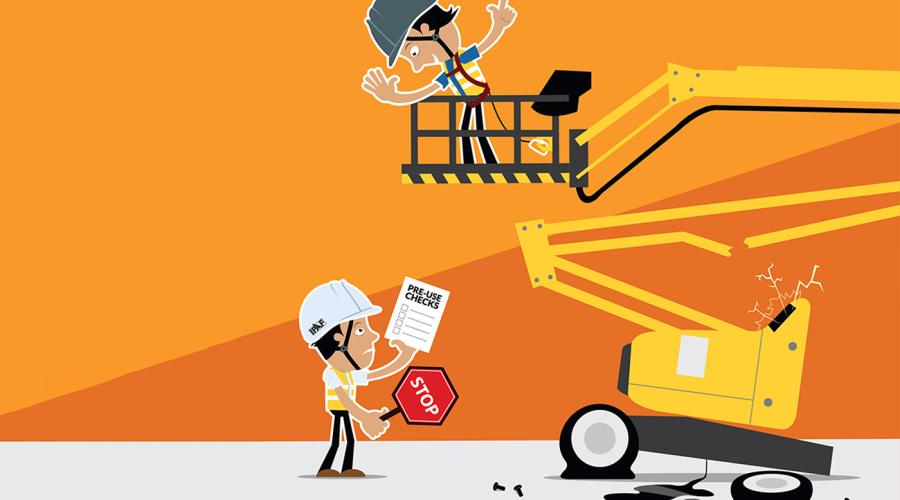
A MEWP should be inspected, and the inspection documented, every morning prior to use. The Lifting Operations and Lifting Equipment Regulations (LOLER) 1998, Regulation 9 states that:
"Every employer shall ensure that lifting equipment which is exposed to conditions causing deterioration which is liable to result in dangerous situations is-" "Thoroughly examined-" "In the case of lifting equipment for lifting persons or an accessory for lifting, at least every 6 months."
-
It varies from job to job - check. Invariably the party paying for the MEWP will be responsible - so check the ground conditions. Assuming otherwise could be expensive if not accounted for in the quote.
-
-
Yes – if it is adjustable and used correctly as a restraint device (adjusted to be as short as possible), the lanyard will not be able to gain sufficient force/momentum to deploy the shock absorbing pack, thereby acting as a restraint lanyard.
-
Employers have responsibility for the health, safety and welfare at work of all of their employees. It is the employer’s duty to assess risks to lone workers and take steps to avoid or control risks where necessary.
Please refer to the HSE guidance paper - Working Alone in Safety: Controlling the risks of solitary work: http://www.hse.gov.uk/pubns/indg73.pdf
-
All MEWPs (except those designed specifically for indoor use) are designed to operate in wind speeds up to a maximum which should be marked on the machine. Operation in wind speeds above this maximum may cause instability.
Under BS EN280:2001+A2:2009 (Mobile elevating work platforms – Design calculations – Stability criteria – Construction – Safety – Examinations and tests) the maximum design wind speed in which a MEWP can work is 12.5 m/s (28 mph). Wind forces are assumed to act horizontally at the centre of area of the parts of the MEWP and persons and equipment on the work platform, and shall be taken to be dynamic forces. This does not apply to MEWPs intended for indoor use only.
Wind speed can be measured using an anemometer.
It is very important to realise that wind speed increases with height and may be 50% greater at a height of 20 metres above ground level.
Care must be taken when handling building cladding, sheet materials, panels and other such materials which can act as "sails" and seriously affect the stability of a MEWP, especially in gusty wind conditions. For the same reason, signboards and the like must not be applied even temporarily to the platform.
You should be aware of the shielding and funnelling effects of high buildings which may cause high wind speeds on days when the wind speed in open areas is low.
Other sources of local high wind speed to consider are aircraft slipstreams at airports and high-sided vehicles on motorways.
-
-
The European law relating to the fitting and use of tachographs to record drivers' hours of work is contained in EC Council Regulation 3821/85.
All vehicles exceeding 3.5 tonnes maximum permissible weight coming within the scope of EC Council Regulation 3820/85 used for carrying goods (including the weight of any trailer drawn) must be fitted with an EC approved tachograph to record not only the driver's hours but, if a second driver is carried, his working periods also.
Exception to this rule: A vehicle carrying goods, having a permissible maximum weight, not exceeding 7.5 tonnes and carrying material or equipment for the driver's use in the course of his work, within a 50 kilometre radius of the place where the vehicle is normally based and provided driving the vehicle is not the driver's main activity. This requirement also applies to journeys made to or through AETR member countries.
See: http://www.dft.gov.uk/vosa/repository/Quick%20guide%20to%20towing%20small%20trailers.pdf
-
IPAF provides the following quick reference guides for suppliers and users.
Issues covered include: • Machine weights and permissible loads • Taxation and regulations affecting vehicle mounted MEWPs used in the highway • Schedule 3, Engineering Plant • Extracts from Statutory Instrument 2003 No. 1998, The Road Vehicles (Authorisation of Special Types) (General) Order 2003 s49-(1) - Vehicles fitted with a moveable platform.
-
Some MEWPs are purchased with the anemometer at the point of order as anemometers are not usually fitted as standard by the manufacturer. In addition, an anemometer can be expensive, can be damaged, and requires regular calibration.
-
New equipment in the European Union (EU) must be delivered with a Certificate of Conformity (also referred to as an EC Declaration of Conformity) to the Machinery Directive (98/37/EC). A Certificate of Conformity is only valid for this purpose for 12 months from its date of issue. But in the case of lifting equipment for lifting persons, the Lifting Operations and Lifting Equipment Regulations (LOLER) consider this documentation to be equivalent to a Certificate of Thorough Examination valid for six months following its date of issue.
-
This is usually because the manufacturer has installed alternative measures to prevent trapping in the scissor pack in line with BS EN280: Mobile elevating work platforms – Design calculations – Stability criteria – Construction – Safety – Examinations and tests.
Source: BS EN 280:2001+A2:2009 – 5.4.4: The downward movement shall be automatically stopped by a safety device in a position, where between the outer ends of the scissors the vertical distance is not less than 50 mm, so that crushing and shearing of fingers cannot occur. Further downward movement shall only be possible after a suitable time delay, giving the operator the opportunity to see, whether persons beside the MEWP could be injured, and a further command of the operator.
-
This is NOT usually allowed as the operator will be unable to judge distances from objects whilst on the ground. However, under certain circumstances and in accordance with a thorough risk assessment, it might be justifiable. An example is that of a cameraman at an event in a position away from all aerial hazards, all possible safety measures having been taken such as briefing the passenger about the emergency lowering controls and having the operator close to hand at the chassis.
-
The use of netting will be a decision based upon a site, job and machine specific risk assessment.
The attaching of netting or other materials to the handrails of a MEWP to prevent tools and materials falling from height will increase the wind resistance of the raised platform. Thus the manufacturer's recommended maximum wind speed will have to be downrated to compensate for any increased resistance of the platform when raised.
The amount it will be reduced will depend on the material fitted. Any reduction in manufacturer's recommended wind speed rating will have to be made known to potential operators of the MEWP. The weight of the material fastened to the handrails will have to be taken into account when considering the safe working load limitations of the MEWP.
The correct positioning of the platform at height in relationship to the task to be performed will be influential in preventing the possibility of tools and materials falling from the platform.
The tethering of tools and materials should be also considered as a possible option to prevent objects falling from the raised platform.
Where netting is fitted to the handrails, it may increase the possible trip hazard to occupants of the platform and also increase the risk of “snagging” from internal or external objects.
Mast Climbing Work Platform (MCWP) Use
-
No – the armour would prevent the cable from collecting in the drum provided by the manufacturer and could cause additional hazards.
-
No, unless a rigorous risk assessment carried out as part of planning the job indicates that this is the safest and most effective means of accessing a particular location, taking into account the availability on site of other more suitable access equipment and the practicability of providing the same within the required timescales for the task to be carried out. This will need to be taken into account during the installation process.
-
The users of a Mast Climbing Work Platform (MCWP) would be expected to have undergone as a minimum: - Basic Health & Safety Awareness training (offered by many organisations)
- Basic MCWP Awareness, Regulations & Guidance
- Product Specific - Operational Controls
- Product Specific - Emergency Systems
- Pre-use / Daily Checks
Demonstration should be completed by a competent person (Demonstrator) who has sufficient knowledge and experience of the MCWP to be used. This demonstration is best completed on site with the specific make and model of MCWP to be used.
IPAF has a training course specific to demonstrators of MCWPs but does not issue licences for Users as their tasks with the MCWP are not deemed sufficient to warrant this level of certification.
Drawn up after consultation with the HSE.
-
-
All MCWPs used out-of-doors or otherwise exposed to wind whilst in service shall be regarded as being affected by a minimum wind pressure in accordance with:
Minimum design wind data, in service Freestanding or MCWP during erection/dismantling: 12,7m/s (Wind velocity), 100N/m2 (Wind pressure) Tied MCWP: 15,5m/s (Wind velocity), 150N/m2 (Wind pressure)
Wind forces are assumed to act horizontally at the centre of the wind area of the exposed structural parts of the MCWP.
Competent Assessed Person (CAP) Programme
-
The CAP (Competent Assessed Person) assessment programme is intended to provide up-to-date guidance for platform engineers on compliance with regulatory requirements and to offer documented evidence that individuals can be regarded as competent persons to plan, manage or carry out thorough examinations of powered access equipment within the context of current legislation. This is achieved through a rigorous assessment.
-
The much coveted CAP (Competent Assessed Person) Card is proof of passing the CAP assessment and the engineer's ability to plan, manage or carry out thorough examinations of powered access equipment. CAP Cards are valid for five years.
-
 |
 |
|
 |